

A story from 998
The Rain Hut
In a forest where it has never stopped raining, somebody always leaves the kettle on.
It has rained in that forest for longer than anyone can remember. That isn’t a figure of speech. I asked.
The woman who kept the guesthouse at the end of the bus route said it had been raining in there since before her mother was born, and her mother had been born in the room I was sleeping in. She told me in the same voice she had used for the breakfast times. Then she gave me directions, which were: stay on the path, and if you lose it, don’t wait for it to stop.
The rain, she meant. Not the path.
The rain in there has rules. I know three of them now. The first is the one she gave me: it doesn’t stop.
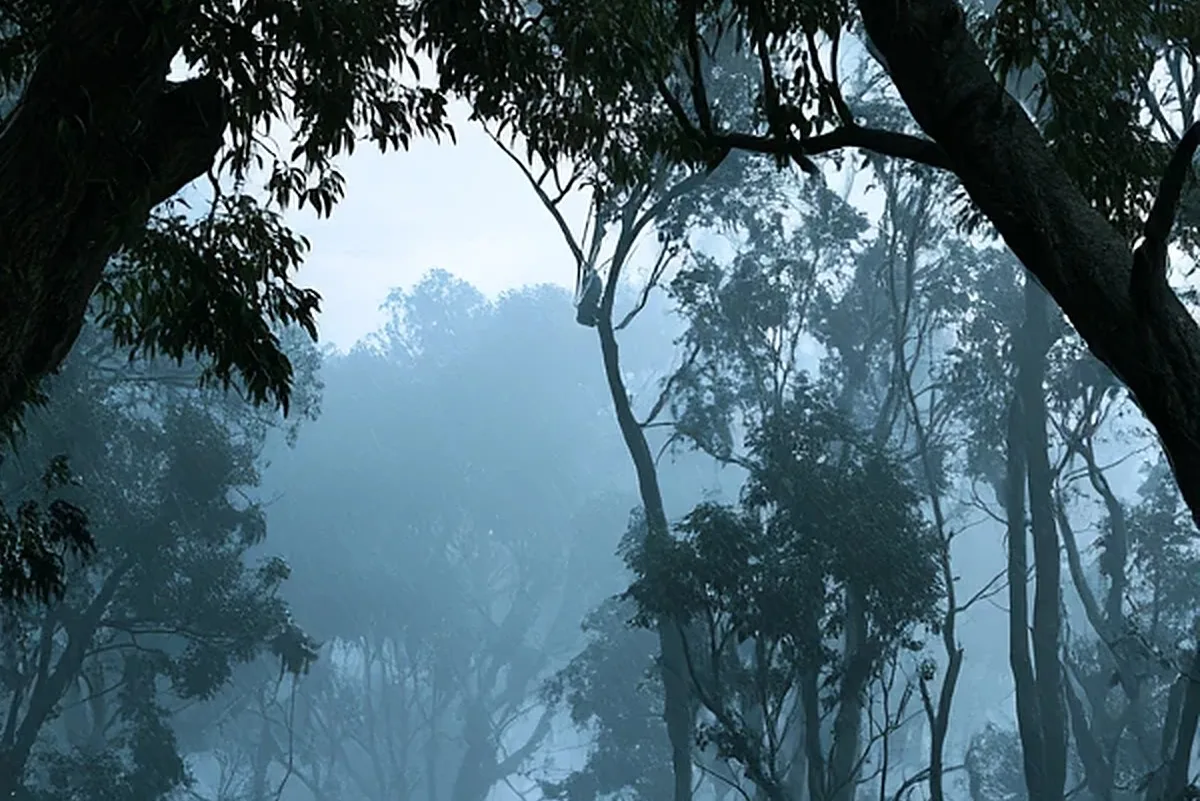
The path was good for a day. The trees were the kind you only get where it is always wet: tall and pale and bare for the first hundred feet, the bark coming away in long grey strips like wallpaper in a house nobody lives in. Moss on everything that stood still long enough. Roots across the path like cables someone had meant to bury and never got round to.
Rain in a forest isn’t one sound. It’s the canopy hissing, a long way up, and the big leaves lower down taking it in single drops, heavy as coins, and under all of it the ground, drinking. After a day you stop hearing it. After two it is a clock in another room: you would only hear it if it stopped.
On the second afternoon the painted marks on the trunks ran out. I don’t know whether they had washed off or had never been there. I kept on in what I was fairly sure was a straight line while the light went green, then grey, then the colour of weak tea, and I understood that I was lost, in the calm way you understand something that has been true for an hour already.
That was when I saw the stone.
A flat one, set in the mud a few yards ahead. Dry. Not drying: dry, the way a stone is dry indoors, pale grey in a forest where everything else was black with wet. I watched the rain find it. It had gone dark by the time I reached it.
There was another beyond it, dry. Then another, a little further on than I would have stepped.
I followed them, because what else do you do. Each one darkened just before I got there, and there was always another, pale in the gloom, just far enough ahead. I didn’t look up. I’m not sure why. I think I thought it would be rude.
After a while there were two small lights low in the trees, orange, the colour of a stove door left open.
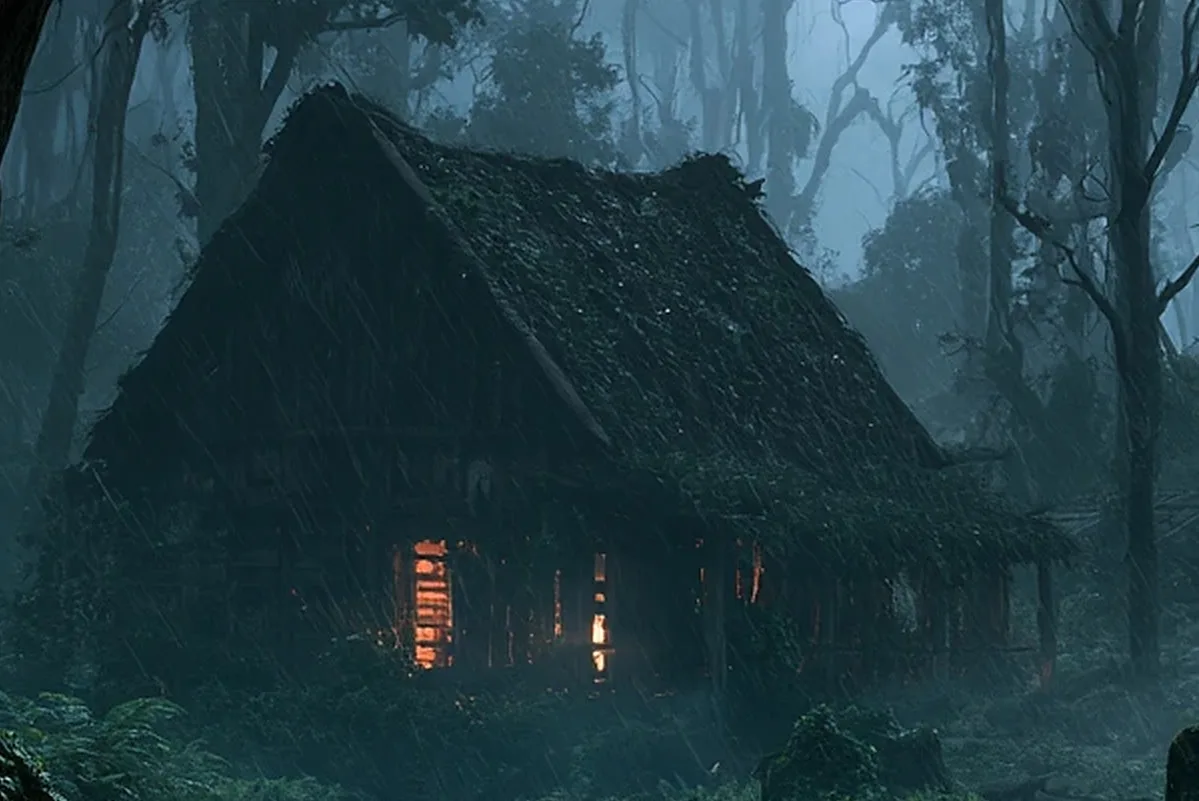
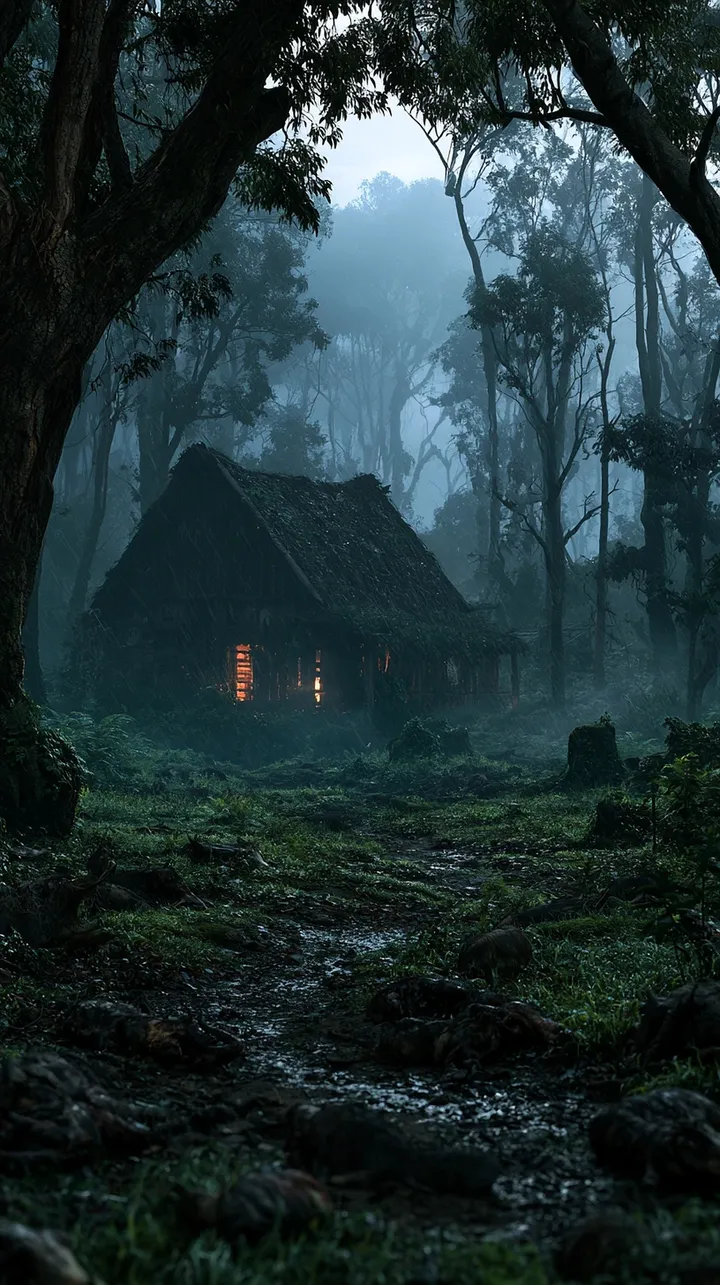
It was a hut, the thatch pulled down low over the walls like a hat over a face. Two windows, both lit. The step was dry. I didn’t think about it; that is what eaves are for.
There was a water butt by the door, and I remember it because it was empty. I looked in, because you do. Dry at the bottom, one brown leaf curled in it. In a forest where it has rained since before anyone’s mother was born.
I knocked. I said hello, a few times, in the voice you use in other people’s houses. Then I went in.
Nobody. Two oil lamps on the sills, wicks trimmed, burning clean. A stove, a table, one chair. On the stove a kettle, and when I put my hand to it, it was warm. Not hot. Warm the way a kettle is warm an hour after someone has made tea and gone out to see about something.
On the table: one cup, upside down on its saucer. A tin of tea. A towel, folded.
I stood on the boards and dripped, or thought I did. When I looked down they were dry, all the way back to the door. I hung my coat on the hook and it was dry before I had the lid off the tea.
At the back of the hut there was a curtain, and behind the curtain a bed, made, with the blanket turned down at one corner. I said hello again, to the curtain. I’d like to say I didn’t feel foolish.
On a shelf above the bed was a ledger, thick as a family Bible, its covers gone soft as cloth. A visitors’ book, ruled by hand into four columns. Date. Name. Address. Remarks.
I read it by the lamp for an hour. Hundreds of entries in hundreds of hands, pencil and biro and fountain pen and something that might have been soot, going back further than the spelling on the early pages made comfortable. The remarks all said more or less the same thing. Lost. Rain. Kettle warm. Nobody home. Thank you to whoever keeps this place.
Nobody had met the keeper. Everybody had thanked them.
A few of the names came up twice, years apart, in handwriting that had got older. The second time, none of them had given an address. One entry near the end said only: Lovely and quiet. Thank you for having me.
The entries were numbered down the margin in brown ink, all in one hand. The last was 997. Beneath it was a blank line, and beside the blank line, in the same ink, someone had already written 998.
I wrote what everyone else had written. I put my address in too, because there was a column for it. Then I got into the bed that had been turned down for me and slept like something that had been put away.
I woke in the small hours without knowing why, and lay still, and listened.
Rain on the leaves. Rain on the path. Rain in the canopy, hissing, a long way up.
Not on the roof.
I was lying under a thatched roof in a forest where it had not stopped raining in living memory, and the roof made no sound at all. I had been under it for seven hours. It had taken me that long to hear it.
I got up. The lamps were still lit, and the oil stood higher in the glass than when I had gone to bed. The kettle was warm. I didn’t call out this time.
I opened the door.
The rain was coming down a yard from the hut. Not off the eaves: a yard beyond them, all the way round, in one straight unbroken line, like water off the rim of an umbrella. Between that line and the walls the ground was pale. There was dust on the step. The water butt stood inside the line.
I put my hand out through it. Ordinary rain, cold, on my palm. I brought my hand back in, and it was dry before I had closed my fingers.
I thought about the stones on the path, each one dry until the moment before I reached it. I had known the second rule since then; I just hadn’t put it into words. The rain doesn’t fall where the keeper stands.
I had only assumed the keeper was about my size.
I did look up. I want to be honest about that, because it would be easy to say I didn’t. There was nothing to see. Only dark, and the dark was nearer than the sky should have been, and it was holding very still, the way you hold still over something you don’t want to startle.
I shut the door and sat by the stove until it was light, holding the cup that had been left out for me. The roof said nothing. I have never felt so looked after.
I left at first light, what passes for it in there, and I didn’t follow any stones.
I stepped out through the line of rain and stood in it with my face turned up, like a child. Cold down my collar, in my eyes, over the tops of my boots. Rain on my head meant nothing was standing over me. I walked for six hours on that alone.
Before the trees closed behind me I looked back, once. I had put the lamps out. I know I did. I stood in the doorway and watched both flames go blue and small and then go out.
One window was lit.
I learned the third rule at home.
I came out onto a road I didn’t know, and a lorry took me to a town with a station, and a train took me the rest of the way. It wasn’t raining when I got there. I remember standing on the pavement outside my own front door with my face turned up to a dry grey sky, making sure.
It started that evening, a little after dark, and it hasn’t stopped.
I was filling the kettle when it began. My boots were on the mat where I had left them, still full of the forest. By the time the kettle boiled, they were dry.
Nineteen days. It’s been on the news: wettest autumn since records began, the river over the playing fields, sandbags outside the chemist’s, families from the low end of town sleeping in the school hall. People in the shop talk about it like weather, as though it will run out.
I don’t talk about it.
The kettle is warm when I come down in the mornings. I’ve stopped checking whether I left it on. Last week, without quite deciding to, I started leaving out a second cup.
I’ve been thinking about the names that came up twice, and the column they left blank.
At night I lie awake and listen to it: on the slates, in the gutters, on the bins, on every roof in the street.
Every roof but mine.
The end.